If you've been writing ABAP for more than a few years, you've probably dealt with the older RAISE EXCEPTION TYPE cx_sy_move_cast_error pattern without fully understanding what's happening underneath. ABAP class-based exceptions are one of those topics that seems straightforward on the surface — until you're designing a large SAP S/4HANA system and suddenly realize your error handling strategy is a patchwork of SY-SUBRC checks, message classes, and half-hearted TRY...CATCH blocks. In this article, I want to walk you through class-based exceptions the way I wish someone had walked me through them early in my career: from the fundamentals all the way to production-ready exception hierarchies that actually scale.
Why Class-Based Exceptions Beat the Old Approach
Let me be blunt: checking sy-subrc after every function module call is error-prone, noisy, and nearly impossible to maintain in large codebases. The classic approach relies on the developer remembering to check the return code. Miss one check, and you silently corrupt data or produce wrong output.
Class-based exceptions, introduced properly with ABAP Objects, give you:
- Type safety — exceptions are objects with attributes, not just numeric codes
- Inheritance hierarchies — you can catch at different levels of specificity
- Context data — pass rich error information alongside the exception
- Compiler enforcement — checked exceptions force callers to handle errors explicitly
- Testability — exception classes integrate cleanly with ABAP Unit
The difference in real systems is enormous. I've seen codebases where migrating from function-module-style error handling to proper class-based exceptions cut debugging time by more than half, simply because errors now carried meaningful context instead of just a number.
The Three Exception Categories You Must Know
ABAP gives you three base classes for exceptions, and picking the right one matters architecturally.
CX_STATIC_CHECK — The Checked Exception
Inheriting from CX_STATIC_CHECK means the compiler will warn callers if they don't handle or re-raise the exception. Use this for recoverable, expected business errors — things like a customer not found, an invalid material number, or a business rule violation. Your caller should know this can happen and decide what to do about it.
CX_DYNAMIC_CHECK — The Runtime Exception
Inheriting from CX_DYNAMIC_CHECK gives you an exception that's only checked at runtime. The compiler doesn't enforce handling. Use this for programming errors or precondition violations — things like a null reference being passed where one isn't allowed. Similar in spirit to Java's RuntimeException.
CX_NO_CHECK — The Unchecked Exception
No compile-time checking at all. Reserved for truly unrecoverable situations — memory errors, system failures. In application code, you should rarely (if ever) be inheriting from this directly.
My rule of thumb: when in doubt, start with CX_STATIC_CHECK. It forces good discipline on your team. You can always relax the constraint later.
Designing a Production-Grade Exception Hierarchy
Here's where most tutorials stop too early. They show you how to raise and catch a single exception class, but they don't show you how to design a hierarchy that scales across a whole application domain. Let me fix that.
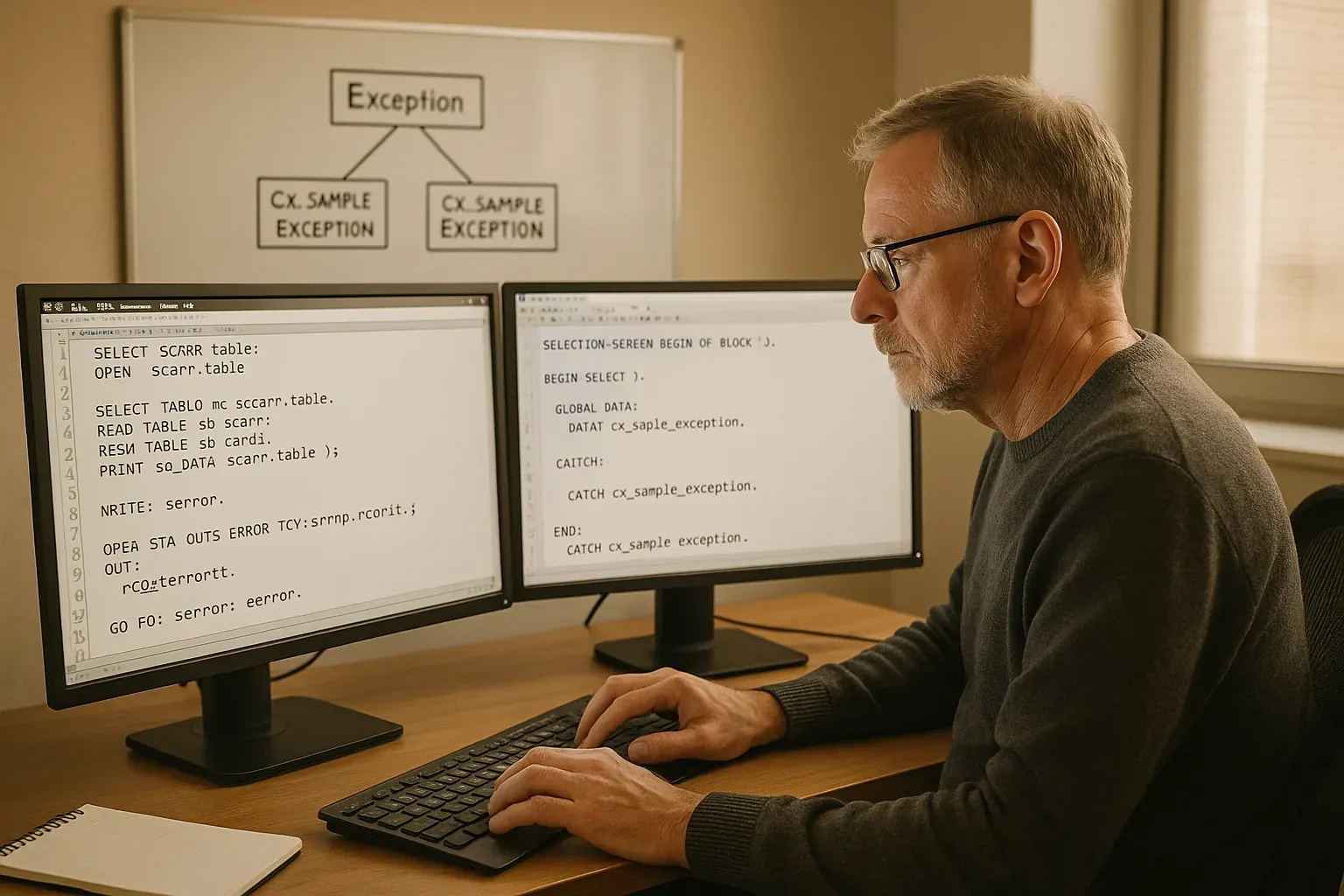
Imagine you're building a custom procurement module. A well-designed hierarchy might look like this:
CX_STATIC_CHECK
  └── ZCX_PROCUREMENT_BASE          " Base for all procurement errors
        ├── ZCX_VENDOR_ERROR          " Vendor-related errors
        │     ├── ZCX_VENDOR_NOT_FOUND
        │     └── ZCX_VENDOR_BLOCKED
        ├── ZCX_PO_ERROR              " Purchase order errors
        │     ├── ZCX_PO_BUDGET_EXCEEDED
        │     └── ZCX_PO_APPROVAL_MISSING
        └── ZCX_MATERIAL_ERROR        " Material-related errors
              └── ZCX_MATERIAL_NOT_AVAILABLE
This structure lets callers choose their granularity. A high-level orchestrator might catch ZCX_PROCUREMENT_BASE and log everything. A specific handler deep in the call stack might only care about ZCX_VENDOR_BLOCKED and trigger a vendor re-evaluation workflow.
Creating Exception Classes in SE24 and Eclipse ADT
In Eclipse ADT (which you should be using for modern ABAP development), create a new class, set the category to "Exception Class", and choose your superclass. You'll get a generated class shell with the standard exception infrastructure already in place.
The key thing to customize is the constructor — this is where you attach meaningful context to your exception. Here's a concrete example:
CLASS zcx_vendor_not_found DEFINITION
  PUBLIC
  INHERITING FROM zcx_vendor_error
  FINAL
  CREATE PUBLIC.

  PUBLIC SECTION.
    INTERFACES if_t100_dyn_msg.
    INTERFACES if_t100_message.

    CONSTANTS:
      BEGIN OF zcx_vendor_not_found,
        msgid TYPE symsgid VALUE 'ZPROCUREMENT',
        msgno TYPE symsgno VALUE '001',
        attr1 TYPE scx_attrname VALUE 'VENDOR_ID',
        attr2 TYPE scx_attrname VALUE '',
        attr3 TYPE scx_attrname VALUE '',
        attr4 TYPE scx_attrname VALUE '',
      END OF zcx_vendor_not_found.

    DATA vendor_id TYPE lifnr READ-ONLY.

    METHODS constructor
      IMPORTING
        !textid   LIKE if_t100_message=>t100key OPTIONAL
        !previous LIKE previous                 OPTIONAL
        !vendor_id TYPE lifnr.

ENDCLASS.

CLASS zcx_vendor_not_found IMPLEMENTATION.

  METHOD constructor.
    CALL METHOD super->constructor
      EXPORTING
        textid   = COND #( WHEN textid IS INITIAL
                           THEN zcx_vendor_not_found
                           ELSE textid )
        previous = previous.
    me->vendor_id = vendor_id.
  ENDMETHOD.

ENDCLASS.
Notice I'm storing vendor_id as an attribute. When this exception lands in a catch block anywhere in the call chain, the handler knows exactly which vendor caused the problem — no digging through logs needed.
Raising and Catching: The Practical Patterns
Raising with Context
METHOD get_vendor.
  SELECT SINGLE * FROM lfa1
    INTO @DATA(vendor_data)
    WHERE lifnr = @iv_vendor_id.

  IF sy-subrc <> 0.
    RAISE EXCEPTION TYPE zcx_vendor_not_found
      EXPORTING
        vendor_id = iv_vendor_id.
  ENDIF.

  rv_vendor = vendor_data.
ENDMETHOD.
Catching at the Right Level
METHOD process_purchase_order.
  TRY.
    DATA(vendor) = get_vendor( iv_vendor_id = lv_vendor_id ).
    DATA(material) = get_material( iv_material = lv_material ).
    create_po_header( vendor = vendor material = material ).

  CATCH zcx_vendor_blocked INTO DATA(vendor_blocked_exc).
    " Specific handling: trigger vendor review workflow
    trigger_vendor_review( vendor_blocked_exc->vendor_id ).
    log_warning( vendor_blocked_exc->get_text( ) ).

  CATCH zcx_vendor_error INTO DATA(vendor_exc).
    " Broader catch: any other vendor problem
    log_error( vendor_exc->get_text( ) ).
    RAISE EXCEPTION TYPE zcx_po_error
      EXPORTING
        previous = vendor_exc.  " Exception chaining!

  CATCH zcx_procurement_base INTO DATA(base_exc).
    " Safety net for anything we didn't anticipate
    log_error( base_exc->get_text( ) ).
    RAISE EXCEPTION TYPE zcx_po_error
      EXPORTING previous = base_exc.
  ENDTRY.
ENDMETHOD.
Notice the previous parameter — that's exception chaining, one of the most underused features. By passing the original exception as previous, you create a full exception stack trace. When you call get_previous( ) on the outer exception, you get the inner one back. This is invaluable for root-cause analysis in production.
Exception Chaining: Your Production Debugging Superpower
Let me show you a small utility method I use in almost every project to extract the full exception chain for logging:
METHOD get_full_exception_text.
  DATA(current_exc) = CAST cx_root( io_exception ).
  DATA(result) = ||

  WHILE current_exc IS BOUND.
    result = result && current_exc->get_text( ) && ` | `.
    current_exc = current_exc->get_previous( ).
  ENDWHILE.

  rv_text = result.
ENDMETHOD.
Run this in a catch block and you get a full breadcrumb trail: "PO creation failed | Vendor error | Vendor 100234 not found." That single log entry tells the whole story. No more log spelunking across multiple entries trying to piece together what happened.
The IF_T100_MESSAGE Interface: Making Exceptions Work with Message Classes
In real SAP systems, you often need exceptions to integrate with T100 message classes — the same messages used in BAPIs, dialog programs, and workflow notifications. If your exception class implements IF_T100_MESSAGE (which the standard exception wizard sets up automatically when you use message IDs), you get:
- Automatic text resolution via the message class
- Translatable exception messages
- Compatibility with standard message containers used in RAP and other frameworks
For RAP-based development especially, this integration is non-negotiable. Your exceptions need to speak the same language as the framework's message handling infrastructure. If you're working with RAP business objects, have a look at our deep dive on RAP business logic validations and determinations to see how exception handling fits into that broader context.
Testing Exception Hierarchies with ABAP Unit
One of the most compelling arguments for class-based exceptions over sy-subrc is testability. With ABAP Unit, you can assert that a method raises a specific exception under specific conditions, and you can inspect the exception's attributes.
METHOD test_vendor_not_found_raises_exc.
  " Arrange
  DATA(cut) = NEW zcl_vendor_service( ).

  " Act & Assert
  TRY.
    cut->get_vendor( iv_vendor_id = 'NONEXISTENT' ).
    cl_abap_unit_assert=>fail(
      msg = 'Expected exception was not raised' ).

  CATCH zcx_vendor_not_found INTO DATA(exc).
    cl_abap_unit_assert=>assert_equals(
      exp = 'NONEXISTENT'
      act = exc->vendor_id
      msg = 'Wrong vendor ID in exception' ).
  ENDTRY.
ENDMETHOD.
This test is self-documenting. Anyone reading it immediately understands: when a non-existent vendor is requested, the service raises ZCX_VENDOR_NOT_FOUND and the exception carries the vendor ID that was looked up. For more on building robust test suites in ABAP, the series on ABAP Unit Testing with test doubles and mocking frameworks pairs well with what we're doing here — especially when you need to mock dependencies that your exception-raising code calls internally.
Common Mistakes to Avoid
1. Catching CX_ROOT Everywhere
Catching CX_ROOT as a blanket safety net in business logic is the exception-handling equivalent of CATCH EXCEPTION in the old days. It swallows errors you should be handling specifically. Reserve CX_ROOT catches for top-level handlers — program entry points, RFC function modules, and similar boundaries.
2. Building Flat Exception Namespaces
Creating ZCX_ERROR_001, ZCX_ERROR_002, ZCX_ERROR_003 without a proper hierarchy defeats the purpose. You lose the ability to catch at different granularities and your callers have to enumerate every possible exception type.
3. Losing Context on Re-Raise
Always use the previous parameter when re-raising. Raising a new exception without linking the previous one buries the root cause and makes debugging far harder than it needs to be.
4. Putting Business Logic in Exception Constructors
Exception constructors should do one thing: store context. Don't call database reads or call other services from inside a constructor. Keep it simple and side-effect-free.
Practical Naming Conventions for Large Projects
On enterprise projects with multiple teams, naming discipline matters. Here's the convention I've settled on after several large implementations:
ZCX_[DOMAIN]_BASE— root exception for each application domainZCX_[DOMAIN]_[ENTITY]_[PROBLEM]— specific exceptions (e.g.,ZCX_FI_POSTING_PERIOD_CLOSED)- Keep domain abbreviations consistent with your package/namespace structure
- Document each class with a one-line description of when it's raised
This convention means any developer can look at an exception class name and immediately understand its domain, the entity involved, and the problem it represents — without opening the class definition.
When you're applying these patterns inside OOP-heavy designs, especially those using strategy or command patterns, the error hierarchy design becomes even more critical. Check out the article on ABAP OOP design patterns including Strategy and Command patterns to see how exception handling fits into those architectural patterns in practice.
Wrapping Up: A Checklist for Production-Ready Exception Handling
Before you ship any significant ABAP component, run through this checklist:
- ✅ Each application domain has a base exception class inheriting from
CX_STATIC_CHECK - ✅ Specific exception classes carry all relevant context as typed attributes
- ✅ Exception constructors are lean — no side effects, just attribute assignment
- ✅ Re-raises always chain to the previous exception
- ✅ Exception classes integrate with T100 message classes for translatable texts
- ✅ ABAP Unit tests verify both the happy path and the exception-raising paths
- ✅ No naked
CX_ROOTcatches in business logic layers
ABAP class-based exceptions done right are one of those invisible quality investments — users never see them directly, but your support team, your fellow developers, and your future self will thank you every time a production incident lands on your desk and you can trace the exact root cause from a single log entry rather than spending hours in debugging sessions. For more on how these principles connect to dependency management and clean architecture, the guide on ABAP unit testing with dependency injection is a great next read.
Start small — pick one module you're working on right now and design a proper exception hierarchy for it. Once you see the difference in code clarity and debuggability, you won't go back.
What's your current exception handling approach in ABAP? Are you still on sy-subrc, partially migrated, or fully on class-based exceptions? Drop a comment or reach out — I'd love to hear what patterns have worked (or haven't) for your team.
Further Reading
For another architectural decision framework, see BAdIs vs Enhancement Spots vs User Exits: A Modern Architect's Decision Framework.